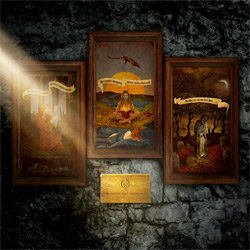
Whether intentional or not, Opeth‘s 2011 album “Heritage” clearly set the stage for “Pale Communion“. For it was that transitionary affair that unmistakably signaled the shift away from the death metal scene/influence that birthed them. “Pale Communion” further pushes along that evolutionary process—and the cocoon has now officially been shed. Opeth 2014 are a graceful progressive metal outfit obsessed with 70’s groove and engrossing atmosphere.
That stylistic shift remains key, but not paramount. Anyone who experienced “Heritage” could have easily forecasted the direction the band were headed in. The initial shock of a melodic Opeth has come and gone and “Pale Communion” is left to grow without the expectation of growls and distortion. The organic tones and analog nature of the songs contained within prove fertile soil for the band to till. From the warm, bouncy production to the jam room improvised flair that pervades the songwriting, this is an album that sounds unequivocally human.
Drawing closely from the likes of Emerson, Lake & Palmer, Mahavishnu Orchestra and King Crimson, the group tackle the adventurousness of 1970’s prog rock full-on, but strive for immersive atmosphere instead of dopey freakouts. A layered framework eases the gradual ascent (or descent) of the lengthy tracks that populate this album and actually keeps them on a solid heading. Indeed, each song is nearly a journey in its own right, and while a few fail to reach a destination, the majority are astonishingly focused sonic voyages.
While frontman Mikael Åkerfeldt‘s delicate playing and wistful croons often nip like a cold wind, they are more of an anchor against the creative storm. The most engaging force remains the inspired contributions of drummer Martin “Axe” Axenrot; his intricate cymbal work on this effort alone should be required listening for up and coming musicians. There’s an engrossing rhythmic beauty to the way he hits the proverbial brass as a part of the actual kit, rather than an extension of it, and the production almost goes out of its way to highlight it.
The dexterous keys of Joakim Svalberg are also enthralling, providing warm organ and synth tones that linger with intrigue, blanketing Axenrot‘s more uproarious percussion with inviting texture. It’s a relaxed tug of war between delicacy and fervor that all musicians involved participate in and yet no clear winner is ever crowned—nor do they need to be. For this offering feels like the earnest work of a collective.
While laced with talent from every musician involved, “Pale Communion” isn’t about ego or chops. It’s a stunning exhibition of unfiltered, heady musicianship that will excite progheads and likely continue to infuriate a key portion of the bands earlier fans.
The second act does suffer some some pacing issues and a few tracks fall short of the high bar set by the livelier compositions. But as a whole, Opeth continue to impress with the bold steps they have taken, even though most of them as of late couldn’t be further away from where the band first gained a foothold.