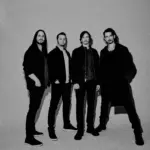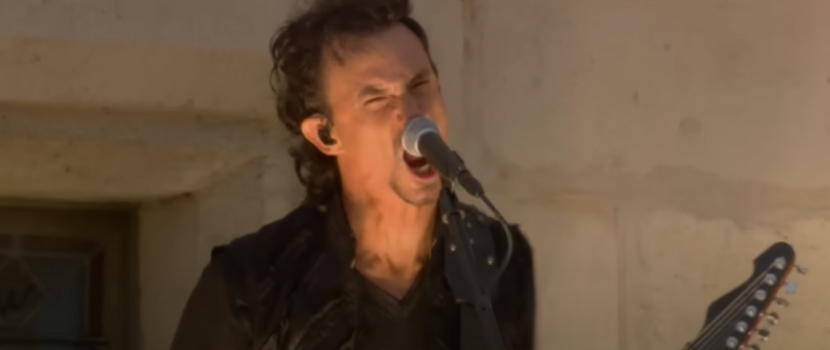
Gojira‘s live performance at the opening ceremony for the Paris Olympic Games last Friday, July 26th was an unlikely milestone for the genre of metal. The progressive French metal band turned heads with their French Revolution-inspired performance of “Ah! Ça Ira” — a French anthem dating back to the late 1700s.
Amid a spectacle that also featured performances from pop megastars Lady Gaga and Celine Dion, Gojira were given an elaborate amount of stage production that included heaps of pyro, suspended performance platforms from the windows of a palace, and somewhat bizarrely, a live-action beheaded Marie Antoinette.
The spotlight was of course not solely Gojira‘s, as mezzo-soprano Marina Viotti collaborated with the band on the track, arriving on a ship as Gojira performed from the windows of the Conciergerie Palace in Paris, France. A small army of classical musicians backed the aforementioned pair.
While those not versed in French revolutionary history may have found the performance to be disturbingly morbid, or as others decried, ‘satanic’, the presence of Antoinette was an ode to France’s bloody history. Antoinette was the last queen consort of France before The French Revolution, and for a time was imprisoned at the Conciergerie palace before being beheaded for the crime of high treason.
Gojira vocalist recently discussed how the aforementioned landmark moment in representation for heavy music on the world stage came about with Rolling Stone, offering:
“It’s been in the works for months. Ever since we were contacted by the Olympic Committee and the composer, Victor le Masne, I wasn’t sure what was going to happen just because it sounded completely unreal. The amount of people that would see us live kind of eclipsed the moment. I wasn’t thinking about what it was going to be because it was just too mind-bending to think about. So the reality of the moment was absolutely mind-blowing from where we were, up there at the Conciergerie and the view we had of the scenery and all the Olympic teams, passing by on boats. It was pretty surreal.”
As for the opportunity to actually play the opening ceremony and the significance it represented, he offered:
“The Olympic Committee could have asked literally anybody to play. I’m thinking of bands like Metallica or AC/DC that are household names and powerhouses in our genre that we all revere and are our heroes. We never considered ourselves the biggest band in the world that would be worthy to play the Olympics or anything like that. It’s so weird.
The way I think about it is it’s a challenge in 2024 to give hope to people, to show something original. People have seen everything from landing on the moon to AI. So it was a challenge for Paris and the Committee to express something fresh, new, and original [by booking us] and also show what France is all about.
At least for our part, the fact that metal and opera had never been seen together on TV and in front of so many people before is a statement for the country of France. It’s saying, ‘Hey, look. We’re still pushing the boundaries in the world.’ So congrats to France for putting this together.”
Regarding the song choice, Duplantier commented:
“That wasn’t us at all. That was the team of young people and composers and designers that decided the whole theme. We were in the dark when it came to the whole ceremony; we were just concentrating on that picture and that moment of Marie Antoinette. We didn’t know how it was going to look or how it would fit in with a whole performance.
I didn’t know Lady Gaga or Celine Dion were going to be there. We were in [the Olympic Committee’s] confidence, and we weren’t allowed to tell our people that we were going to do this. We didn’t know what was going to happen at all. We just went back and forth with the composer of the Olympic ceremony, Victor le Masne. He threw us a tempo and a guideline. And then we did our thing.”
Gojira also had freedom with their own metallized interpretation of the track, as Duplantier explained:
“We very simply and organically came up with riffs and grooves that we like to play. We took it as an opportunity to represent the metal scene. So it was our task to really go for it and lay it down, not just be there and play a few notes to shock people. We decided to go full-on with double-kick drums, screaming, growling, epic moments, and a tempo breakdown at the end; we really wanted to show what metal is all about. And to our surprise, it was all accepted by the committee.
But they gave us some guidelines and things that were mandatory, for example, saying ‘Ah! Ça Ira’ which I ended up saying three times in the song. It’s rare for me to sing in French in Gojira. So it was a bit of a challenge. I was the one pushing to put some English in the middle of the song to make it more international.”
As for claims of the performance being satanic, Duplantier instead viewed it as a celebration of France’s storied history, stating:
“It’s none of that. It’s French history. It’s French charm, you know, beheaded people, red wine, and blood all over the place — it’s romantic, it’s normal. There’s nothing satanic [laughs]. France is a country that made a separation between the state and religion during the revolution. And it’s something very important, very dear to the foundation of republican France.
We call it laïcité. It’s when the state is not religious anymore, so therefore it’s free in terms of expression and symbolism. It’s all about history and facts. We don’t look too close closely at symbolism in terms of religion.”
You can find out more on how the performance came to pass, and Duplantier‘s thoughts on it via Rolling Stone.