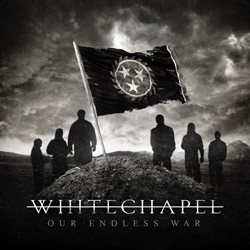
Deathcore was once a fledgling movement that along with djent, brought 7-string guitars out of nu metal’s maligned shadow and back into the hands of would-be shredders everywhere. These days you’d be lucky to find a local metal show flyer without at least one band tuning such a guitar to the top three letters of the alphabet.
Whitechapel are quite aware of this and return with more death and less core strapped within their proverbial bandoliers. Genre pigeonholing aside however, “Our Endless War” is an album fueled by mood and governed by transition.
Vocalist Phil Bozeman‘s blunted delivery and guttural barks still take prime focus. The rest of the band also continue to fall in line with ravenous grooves and a flailing triple-attack guitar onslaught.
But this effort isn’t content to merely be another chapter in a canon already established. The band stay friendly with their deathcore trappings, but seem far more interested in defining themselves and widening their scope. The armory of blastbeats, exacting guitar work and larynx flattening bellows remain. But ever so increasingly key traits of their apparent influences are being stitched in to better distinguish the outfit from their peers.
To that end the title track embraces the ethos of traditional hardcore. Barked choruses and blatantly political lyrical content serve as the first strike for a lively percussive battering and some heaving riffery. If not for a few modern touches “Mono” very well could have embedded itself inside Slipknot‘s earlier discography. There’s also numerous moments of moody atomspherics and a few piles of traditional death and thrash wreckage strewn about as well.
Disturbingly though, the most lively moments on “Our Endless War” are also generally the most thin. Streamlined intent hijacks the strength (and depth for that matter) of more than a few of the songs. “The Saw Is The Law” seems like an Emmure-sque attempt at silencing their detractors. Likewise, the brazen trudge of the chorus found on “Worship The Digital Age” drifts close to the sing-along territory of Suicide Silence. It’s a guaranteed placeholder for crowd interaction, but its thinly veiled purpose is laid bare in a recorded environment—even if the warnings of digital conditioning are a cause worthy of championing.
The group also try their hands at distended song structuring on tracks such as “Psychopathy” and “Diggs Road“; adapting mid-career Chimaira-like atmospherics and epic solos with a touch more rigidity. It is in this muddled pacing that the album can often get hung up though. Whitechapel‘s strength has consistently resided in their face value brutality and unyielding pummel.
There are just too many times when the murk of the various sonic entanglements drain the intended frenzy of its velocity. For every serrated riff and enraged howl there’s another tug downward as the numbingly slow pace takes hold. You can see the direction the band want to go in, but can’t help but feel that be it time constraints, uncertainty or what have you; they just weren’t able to ever fully reach it.
In limited doses this would have been easily overlooked. But there’s a glut of tracks in this vein featured on this album that eventually clog the arteries. With a band that thrives on bloodshed as much as Whitechapel does, this lack of heightened blood flow can quickly take a hefty toll.