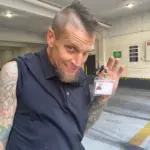
Former American Head Charge vocalist Cameron Heacock appeared on a recently shared episode of the Soft White Underbelly podcast (see below) to discuss his life story, as well as the history of his aforementioned industrial nü-metal outfit. During the course of this chat, Heacock also spoke candidly about his longtime struggles with drug addiction and homelessness.
Tragically drugs and substance abuse sadly played a substantial role in the history of American Head Charge, claiming the lives of two members. The band’s last album “Tango Umbrella“, arrived back in 2016, with the outfit having been dormant since Heacock‘s arrest in 2018.
Heacock was arrested on April 11th, 2018 in Costa Mesa, CA after being found driving a van allegedly containing over a dozen stolen guitars, nine of which were said to have been taken from a Guitar Center location in Fountain Valley, CA. A stolen motorbike and other allegedly ill-gotten gains were found in the van at the time of his arrest. In the years prior to that incident, he had already amassed several drug possession charges.
In this new interview, Heacock, who stated he has been homeless for a number of years now and continues to struggle with his drug addiction, first looked back at his early life, including how System Of A Down advocated for American Head Charge to producer Rick Rubin (Johnny Cash, Slayer). It was that mention that ultimately saw Rubin sign the band to his American Recordings label and personally oversee their 2001 sophomore album “The War Of Art“.
While that union with Rubin was short-lived, it did set the stage for the career the band would manage to build for themselves. During this new podcast appearance, Heacock also touched upon one of the first incidents that sent the band reeling on the road: the death of their guitarist Bryan Ottoson. During a 2005 tour with Mudvayne, Life Of Agony and bloodsimple., Ottoson died on the band’s tour bus as a result of accidental prescription drug overdose.
Reflecting on that moment now and how the band’s inability to properly deal with it, as well the eventual 2017 passing of co-founding bassist Chad Hanks sent him further spiraling out, Heacock stated [transcribed by theprp.com]:
“Unfortunately just smack in the middle of the Mudvayne tour our best friend, and just amazing guitar player person, Bryan Ottoson ended up passing away in the tour bus. And really nobody was prepared for that. We — none of us were — none of us had the tools to, I don’t know, process that. The best thing we could come up with is, you know, Bryan would want us to be out on tour making music if he were in our shoes. And so we went home for like 3 days, buried him, and ended up coming right back out on tour. And we were out of our minds. We didn’t know how to deal with it, how to process it.
So there’s a lot of sideways anger and animosity coming out all over the place to each other to… it was everywhere. And nobody was dealing with it. And then so we did that Static-X tour with a actual friend of Bryan‘s, a guy named Benji [Helberg} who ended up being [our] guitar player off and on for the subsequent years.
But after Bryan died, I really, I love that dude. I loved making music with him. And I didn’t, I just I couldn’t process it. I felt a lot of guilt for his death because he died in part… He had been taking antibiotics for strep throat. He had gotten strep throat for like a second time. He didn’t deal with… He wasn’t able to deal with the rigors of being on tour and and all that goes into that and your immune system’s just got to be on… It’s tough and he just wasn’t used to it. That was his first, well his second, tour and his body was just not handling it.
So he ended up taking some pills that I had. I mean, I was deep in my addiction. I had a jar of pills like about this big and it was just a grab bag of like every opiate, benzo, muscle relaxer. It was… at the time I thought it was awesome, but you know, I think in a lot of ways, had that not been there, Bryan might still be alive.
So I struggle with a lot of guilt over that. It certainly fueled more spiraling and I really kind of turned my back away from the band for a number of years, and then started to write music again. And I just can’t really get away from it. I mean it’s like every record seems to be doomed somehow.
I mean, we did our, when when we released the debut record [‘The War Of Art‘,] when we released that, we released it August 28th. Well, August 28th, 2001. Well, September 11th happened two weeks after we released our record. So, it was, we were doing great. Like, sales wise, we were on course to… you know, other records that have gone gold were right where we were in terms of sales.
Anyway, so that first record had 9/11 happen. The second record had Bryan die. Um, the third record — well, we did an EP actually between the second and and third one — and that one really didn’t have any like major tragedy to it.
But the third one, by the end of it, the guy that I had started with, my bass player [Chad Hanks,] he had had Hepatitis C for a long time [and he] refused to stop drinking. He basically locked himself in a friend’s basement ala ‘Leaving Las Vegas‘; he basically drank himself to death. Drinking just massive bottles of vodka every day until he ended up needing to be in hospice because he all his organs were failing. And so that one I didn’t deal with very well either.
That one was… I mean it, Chad and I had a connection that was otherworldly, and when he died I just really went off the deep end. I had no intention of waking up the next day. So, like my my days were, I was down for whatever. I was doing a lot of stuff that I shouldn’t have been doing. I was hanging out with a lot of people I shouldn’t have been hanging out with.
Luckily I ended up getting arrested randomly. They did, the cops — this is in Orange County at the time, I was living in Orange County at the time — the cops did a sweep of this hotel that I wasn’t staying at, but I was there seeing somebody and they just happened to catch me. And when I walked out of that hotel room, there was mind you the city I was living in — they get a little overboard with the cops — and I came out to like 30 or 40, 20 or 30 cops, all guns drawn.
I look back on that I’m really lucky they did because I had some bad plans with some bad people to do some really nasty stuff. And I’m really glad I didn’t get a chance to do any of that. Anyway, I ended up doing like three months and then I had to do some treatment to satisfy the courts. I did that, came out, and we made our last record.”
So I mean Chad died and I just, like I said, I wasn’t trying to wake up at all, and I kept waking up. And then I got out of jail and somehow my guitar player had bought a house in the hills of Los Angeles. And little did I know that while I was in jail, he had become addicted to slamming meth and had completely lost his mind. He [became] paranoid schizophrenic.
It’s just, he was beyond help. I mean there was nights where [I’d] just hear kicking and screaming and him throwing things around his room and there’s nothing anybody could do about it. He’s screaming at the voices in his head. That’s really I mean… the fact that he got a new girlfriend that was… basically it was just me and him in the house, and it was his house.
But when he got this girlfriend [they became] convinced that she basically wanted a house for herself and him to be alone. I can’t fault them or fault her for that, but you know, it was this is somebody that was like my brother I expected to live to an old age [with] and and he would always be there.
And I came home one night, or one morning, and he had changed the locks. And through the screen door. I said, ‘What’s going on?’ And he just says, ‘I don’t want you in my life anymore.’ That was such a such a gutshot. I didn’t even like, I just, I had no idea that that was anywhere on my horizon. And I had nowhere to go. I had a motorcycle at the time and I ended up homeless.
I ended up homeless down in Echo Park. And I migrated after they closed Echo Park down to a couple different places and then ended up down in good old MacArthur Park and [I’ve] been there for years.
A couple of my friends were looking for me. It sucks because I love music. I love making music. I love the whole process. I love touring. I love everything about it and it’s just been so much negative, like every person I’ve lost in my life has been like almost directly a result of me, or my involvement in the band.
For whatever reason, either I got to fire the person because they’re not doing, you know, what needs to be done, or they die, or they go crazy, or they kick me out of their life because I’ve been doing drugs the entire time they’ve known me, but suddenly now I need to stop. I’ll admit, [they’re] probably right, but I’m a stubborn motherf*cker. And so really I just still have a bunch of music in my mind and my heart.
It’s just bringing myself to do that. I mean, I pour everything into the records when I make them and it’s like I know I have at least two to three records in my head that I want to release. I mean all the music I make is really just for myself, but it’s like my therapy and if I don’t, I don’t I know, I’m going to die.
Heacock‘s former American Head Charge bandmates have also previously recounted the band’s downfall. In this latest interview however, Heacock was then asked if he still lives on the streets, to which he said yes. He was also quizzed about how his current struggles with addiction are going and what he has been taking, he stated:
“Fentanyl. I was slamming heroin off and on for 20 some years. And then I mean, it’s going to sound bad, but fentanyl’s been a blessing. It somehow released me of my… I was so fixated on that needle for so long, and I never thought I [would be able to quit it.] And then somehow, you know, [I] started talking fentanyl and it’s just like that grip that needles had over me and my mind just somehow vanished. So I know it sounds crazy, but fentanyl certainly, it’s been a a godsend. You know, it’s enabled me to put [the needle] down. I never thought I would not be shooting up. I figured however old I made it to, I would be slamming that sh*t.”
Later asked what he feels is his biggest regret, he replied:
“Sh*t man, I got a lot. The biggest one, I guess, is probably not being better to myself and taking care of… like I always put other others before myself. Like [I’m] a people pleaser or whatever, and it didn’t matter what was going on with me. I’d make sure everybody around me… when everybody’s around me is happy, then I feel happy. And I think I did that way too much to the detriment of my sanity. And I think it came out in a lot of ways that it shouldn’t. I certainly regret some relationships.
I regret not ever… I think there’s two things I was supposed to do in this world. One was make music, and one was I thought at one point was to be a father. And you know, obviously there’s… I’m not that old, there’s certainly time, but I regret not… As I didn’t have the right girl. Like, how can I regret? It’s a good thing I didn’t I didn’t have a family with somebody I wouldn’t have wanted to be with.”
When asked why he feels he can’t continue to make music or start a family now, Heacock went on to describe his own “selfishness.” Further pressed if he somehow felt ‘drugs weren’t part of the problem’, Heacock replied:
“Oh, no. For sure they are. I mean, it’s the whole gamut, you know. It’s that selfishness of of just wanting to do what I want to do and doing drugs and yeah that’s for sure the issue.”
He continued:
“It’s just like in my head I’m like it just doesn’t matter, right? That’s just what I want to do and I’ll do it till like clearly till the wheels fall off. I’ve been in and out of jail a bunch and didn’t… I never thought I would be doing that as a youngster, you know?
Later, when asked if he views himself as being homeless for the rest of his life, he replied:
“No, I can’t. I certainly have it in me to… I have been sober for periods of time in the past. And it’s been good. I just… It’s just this allure to that darkness that I seem to gravitate towards. That struggle… I feel like my life needs to be like that or it doesn’t I don’t feel comfortable somehow. I don’t know if that makes sense, but it’s like I don’t know.
I know I have a lot of music I still want to make. I just don’t know if, you know, maybe I’ll just do it by myself and release it and it won’t be the sort of thing that’s a a group anymore. I know there’s a lot of people out there that want to hear what’s been going on.
And I just basically, when my guitar player kicked me out, I was basically… I haven’t talked to anybody for years. And I honestly don’t really want to. They don’t have… I don’t feel like they… I sound like an a**hole when [I say,] “I don’t think they have anything for me.”
Heacock would then go on to redirect the conversation back to the topic of his biggest regret, to which he offered:
“My biggest regret is probably not spending more time with my father before he passed. ‘Cause he had early onset Alzheimer’s and it just came out of nowhere and took him really fast and I thought we had a lot of years left.”